.png)
Understanding Yourself. Schema Theory Explained...(Kind of).

Updated: Jun 5
One thing I've noticed as a psychologist is that there is often a massive gap between psychological theories and how clients understand them.
One of the things I find most helpful in therapy is sharing theories that might help clients make sense of their experiences. Not because we need to label people or fit them into neat little boxes, but because understanding ourselves often helps us make better choices.
Lately, Schema Theory has come up quite a lot in my sessions, so I thought I'd try to explain some of the key ideas in a way that feels a little less intimidating than a textbook.
The challenge is that if you Google "Schema Therapy", one of the first things you'll notice is that it's often associated with personality disorders. Unfortunately, that's usually where many people stop reading.
But here's the thing. Schema Theory isn't just useful for people with diagnoses.
In fact, one of the most important things to understand about Schema Theory is that we all have schemas. Every single one of us.
The theory simply gives us a framework for understanding why we react the way we do, why certain situations trigger us, and why we sometimes find ourselves repeating the same patterns over and over again.
And if we're honest, most of us can probably relate to that.

Why Should You Care About Schema Theory?
Because it helps explain something most of us have experienced. Have you ever found yourself wondering:
Why did I react so strongly to that?
Why do I keep ending up in the same type of relationship?
Why do certain comments affect me more than they should?
Why do I keep repeating patterns I know aren't helping me?
Schema Theory attempts to answer those questions. It's not about diagnosing you. It's about helping you understand yourself.
It All Starts With Our Core Emotional Needs
Schema Theory suggests that we all have a number of core emotional needs during childhood. When these needs are not adequately met, certain schemas can develop.
A schema is essentially a pattern through which we interpret ourselves, other people, and the world around us.
The six core emotional needs are:
1. Safety and Stability
Children need to feel physically and emotionally safe. When they grow up in unpredictable, unstable, or unsafe environments, this need may not be fully met.
2. Secure Attachment
Children need at least one reliable, loving caregiver who provides warmth, comfort, and support.
3. Competence and Independence
Children need support as they gradually move from dependence towards confidence and independence. Overprotection, inconsistency, or lack of support can make this process much more difficult.
4. Freedom to Express Emotions and Needs
Children need opportunities to identify, express, and communicate their feelings in healthy ways.
5. Healthy Limits and Self-Control
Children need guidance in learning how to regulate emotions, tolerate frustration, and manage behaviour appropriately.
6. Playfulness and Spontaneity
Play, creativity, curiosity, and enjoyment are not luxuries. They are fundamental parts of healthy human development and remain important throughout adulthood.
Here's The Important Part
What is important to understand about schemas is that we all have them. Whether they get triggered is another story entirely. Schemas are not active all the time. Most of the time they sit quietly in the background. It usually takes a particular trigger or situation to activate them.
And to make you feel a little better about the fact that we're all just a little bit broken, these reactions are often automatic and outside of our conscious awareness. That's exactly why they can be so difficult to understand. Experts have identified 18 early maladaptive schemas that tend to emerge when core emotional needs are not adequately met.
I won't bore you by listing all 18 here, but they're surprisingly common. If you ever look them up, you'll probably recognise a few that feel familiar.
That's normal.

So What Happens When A Schema Gets Triggered?
Schemas don't sit there all day waiting to cause problems. Most of the time they're relatively quiet. But when something reminds us of an old wound, an unmet need, or a familiar emotional experience, a schema can become activated.
When this happens, we move into what Schema Therapy calls a "schema mode" – a temporary emotional state that influences how we think, feel, and behave. Most schema modes can be grouped into healthy modes and unhealthy modes.
The main classes of schema modes are:
Healthy Modes:
Healthy Adult
The Healthy Adult mode allows us to take responsibility for our choices, regulate emotions, solve problems, and respond thoughtfully rather than react automatically.
Happy or Contented Child
This is the part of us that feels safe, connected, curious, playful, and able to enjoy life.
Unhealthy Child Modes:
Vulnerable Child
The part of us that feels hurt, scared, lonely, rejected, or emotionally overwhelmed.
Angry Child
The part of us that reacts with frustration, anger, or resentment when emotional needs feel unmet.
Impulsive Child
The part of us that seeks immediate gratification and struggles with frustration tolerance.
How We Learn To Cope
Once a schema has been activated, we generally try to protect ourselves. The problem is that the coping strategies we use aren't always helpful. Most can be understood through our familiar fight, flight, and freeze responses.
Fight Response: Overcompensation
Schema overcompensation occurs when we respond by trying to become the complete opposite of what the schema tells us.
For example, someone who developed a deep sense of being flawed or inadequate may become highly achievement-oriented, perfectionistic, or relentlessly driven in an effort to prove the schema wrong.
Flight Response: Avoidance
Because schemas are associated with painful emotions, many people learn to avoid situations that might activate them.
Avoidance can be:
Behavioural (avoiding certain people, places, or situations)
Cognitive (avoiding particular thoughts or memories)
Emotional (shutting down emotionally to avoid painful feelings)
For example, someone with an abandonment schema may avoid getting close to people altogether because intimacy creates the risk of loss. Someone with a failure schema may avoid challenging opportunities because they fear confirming their worst beliefs about themselves.
Freeze Response: Surrender
Schema surrender occurs when we simply accept the schema as true.
We stop challenging it.
We absorb it into our identity.
Someone with an abandonment schema may come to believe that everyone eventually leaves them and may struggle to notice evidence that contradicts this belief. The schema becomes self-perpetuating because every experience is filtered through it.
A Very Simple Way To Think About It
If you've made it this far and you're completely confused, don't worry.
Here's my simplified version.
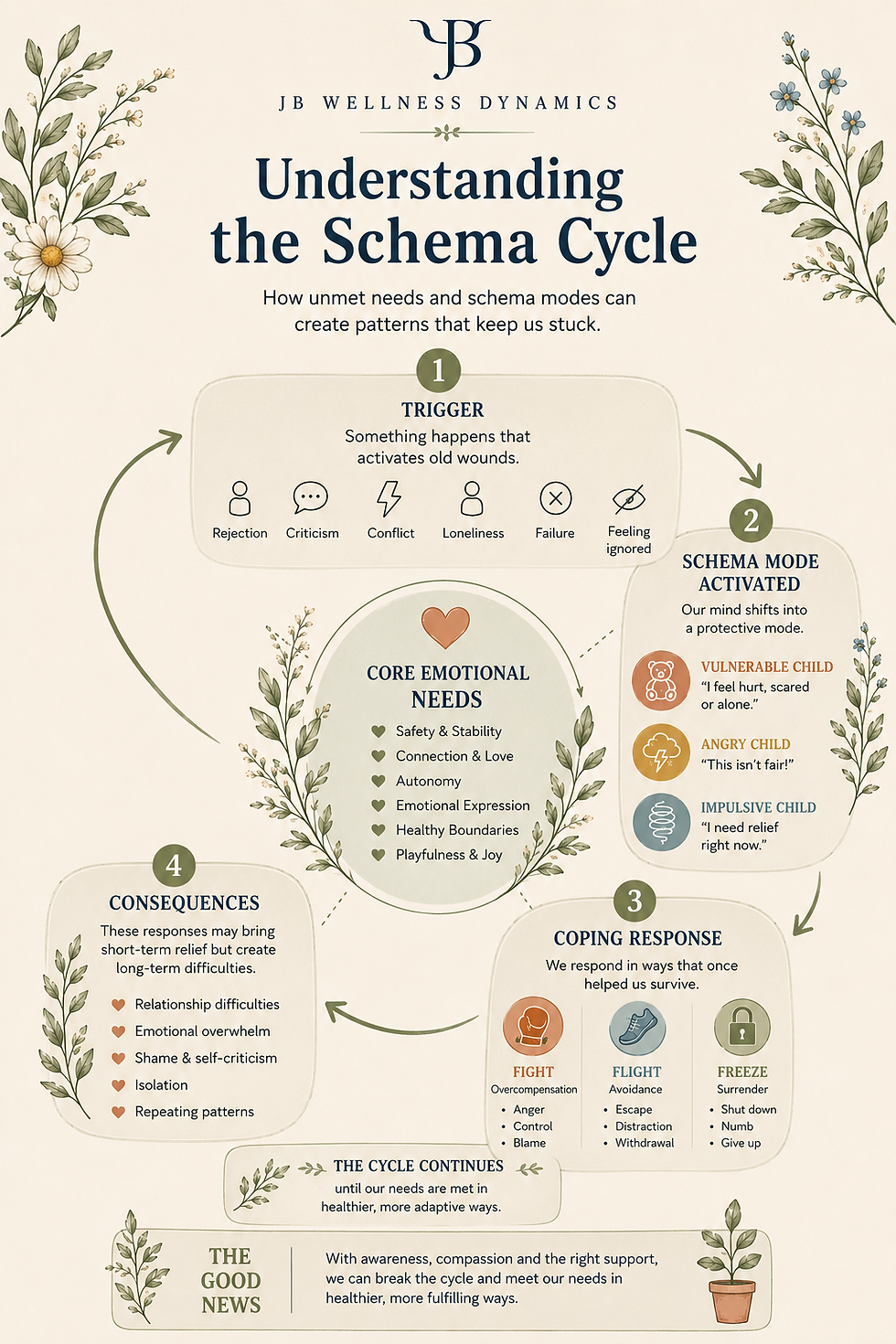
Something happens.
A trigger occurs.
That trigger activates an old schema.
The schema pulls us into a particular emotional state or schema mode.
And then we react using one of our familiar coping strategies.
Fight.
Flight.
Or freeze.
The challenge is that these responses often happen automatically. The opportunity lies in becoming aware of them.
So, at this point in time, if you are completely and utterly confused, here is my very simple, visual way of explaining the theory (Doodle below).
So What Do We Do About It?
The good news is that Schema Therapy isn't about endlessly digging through your past.
It's about understanding patterns in the present. The more awareness we have of our triggers, schemas, and coping styles, the more choice we have in how we respond to them.
In therapy, one of the primary goals is strengthening what Schema Therapy calls the Healthy Adult mode.
This often involves:
Building self-awareness and mindfulness.
Understanding our personal schema patterns.
Identifying cognitive distortions (or, as my clients know them, "mind traps").
Experimenting with new behavioural patterns.
Cultivating self-enhancing activities and habits.
Learning to use emotions as useful information rather than something to fear.
The goal isn't to become a perfect version of yourself. The goal is simply to understand yourself a little better. Because the more we understand why we do what we do, the more freedom we have to choose something different.
Further Reading
Recommended Books
If you've found yourself relating to some of the concepts in this article, these books offer a deeper dive into schemas, attachment, emotional development, and understanding ourselves a little better.
Reinventing Your Life – Jeffrey Young & Janet Klosko
Often considered one of the most accessible introductions to Schema Therapy. This book helps readers identify common life patterns, understand where they may have come from, and explore healthier ways of responding to them.
A Client's Guide to Schema-Focused Cognitive Therapy – David Bricker & Jeffrey Young
Written specifically for clients, this book provides a practical introduction to Schema Therapy and explains many of the concepts discussed in this article in a clear and approachable way.
The Body Keeps the Score – Bessel van der Kolk
A powerful exploration of how life experiences, stress, and trauma can shape both our minds and bodies. This book has helped many people understand the long-lasting impact of difficult experiences.
Attached – Amir Levine & Rachel Heller
An accessible introduction to attachment theory and the ways our early relationship experiences can influence adult relationships.
Mindsight – Daniel Siegel
Siegel introduces the concept of "mindsight" – our ability to understand our own mind and the minds of others. It is a fascinating read for anyone interested in self-awareness, emotional regulation, and personal growth.
The Developing Mind – Daniel Siegel
A more in-depth exploration of how relationships, attachment, and brain development interact to shape who we become. This is a wonderful resource for those wanting a deeper understanding of the science behind human development and emotional wellbeing.
As always, remember that these books are not about finding what is "wrong" with you. They are about understanding yourself, your patterns, your relationships, and your experiences with greater compassion and insight.
You may also find my recommended reading list helpful.
Related Articles



Comments